Saturday, September 5, 2015

Evaluation of General Sources

In this blog post, I will be analyzing two articles on a controversy surrounding the recent revision of the Diagnostic and Statistical Manual of Mental Disorders, or DSM-5. In this most recent revision, the bereavement exclusion criteria for Major Depressive Disorder has been removed. Meaning, grief from the loss of a loved one may now count towards having Depression.

A. Psychiatric Times article

Bergmann, Hannah, "http://www.psychiatrictimes.com/major-depressive-disorder/bereavement-and-dsm-5-one-last-time," September 5, 2015 via screenshot, Attribution Generic 2.0 License

  1. What is the URL? What does the domain name imply? Does this indicate that the source is credible?
  2. Can you identify an author for the information? Can you verify the author's qualifications?
    • The author of this article is Robert W. Pies, MD, from SUNY Upstate Medical University, Syracuse, NY, and Tufts University School of Medicine, Boston.
  3. When was the article last updated? What sort of links are on the page? Where do those links take you? Are they still working?
    • This article was written on December 11, 2012. The DSM-5 was approved on December 1, 2012, but was published in 2013. There are working links to related articles about the DSM on the site. Although this article is three years old, it is still considered relevant because of the subject matter. The DSM is revised once about every ten years. So, the debate surrounding the recent 2013 revision is still pertinent to today's conversation.
  4. What is the text trying to accomplish? Is its purpose to inform, entertain, or persuade the reader? Does it appear to be promoting a commercial product, an idea, a philosophy, or some other way of seeing something?
    • This article's purpose is to answer questions the reader may have about the reasons for the revisions to the DSM. It's purpose is to inform the reader of these reasons and to convince them that this revision serves patients best.
  5. Are there graphics? What do they illustrate and why?
    • There is an image of a man in a gray hoodie outside grabbing some kind fence or cell bars with visible despair. This emotional image serves to set the reader up to view the man as depressed and more readily believe that with the new revisions to the DSM, more depressed people can get the care they need.
  6. Does the source seem biased, one-sided, incomplete, or erroneous? Who profits if viewers of the website believe its information to be true? Can you verify the information with other online or print sources?
    • This source is written by one of the editors of the DSM-5, as revealed within the article. This means the author is likely biased in favor of the revisions made to the DSM. Although the information the author is providing is based on scientific fact, as he cites in his "References" section, the author is notably biased. As an indication of this, the DSM benefits in credibility if viewers believe the author.
  7. Does the source suggest avenues for further inquiry such as possible readings, research, or links? Does it cite reputable sources or note the extent to which claims in the text are connected to recognized authorities in the field?
    • The article sites 7 reputable sources at the end of the article in a "References" section.


B. National Health Services (UK) article

Bergmann, Hannah, "http://www.nhs.uk/news/2013/08august/pages/controversy-mental-health-diagnosis-and-treatment-dsm5.aspx," September 5, 2015 via screenshot, Attribution Generic 2.0 License

  1. What is the URL? What does the domain name imply? Does this indicate that the source is credible?
  2. Can you identify an author for the information? Can you verify the author's qualifications?
    • There is no identified author of the article. The source is marked as edited by NHS Choices, the site it's published on.
  3. When was the article last updated? What sort of links are on the page? Where do those links take you? Are they still working?
    • The article was written on August 15, 2013. There are links to further reading about the DSM from various sites. Most links work but a few do not.
  4. What is the text trying to accomplish? Is its purpose to inform, entertain, or persuade the reader? Does it appear to be promoting a commercial product, an idea, a philosophy, or some other way of seeing something?
    • This text appears to have the purpose of informing its audience about the recent revisions in the DSM. The text also presents both sides of thee argument to explain to readers the depth of the debate.
  5. Are there graphics? What do they illustrate and why?
    • There is a photo of the word "depression" on a dictionary page, highlighting the main focus of the article.
  6. Does the source seem biased, one-sided, incomplete, or erroneous? Who profits if viewers of the website believe its information to be true? Can you verify the information with other online or print sources?
    • The source does seem biased. It is written by the English national healthcare system, and within the article, there seems to be promotion of NHS in comparison to the US's healthcare system. There is even an entire section explaining how many UK doctors are opposed to the DSM because they put the patients first and believe in what they described as an individualized approach to mental health.
  7. Does the source suggest avenues for further inquiry such as possible readings, research, or links? Does it cite reputable sources or note the extent to which claims in the text are connected to recognized authorities in the field?
    • The source provides links to related articles on various reputable sites. It also hyperlinks different related sources within the article.

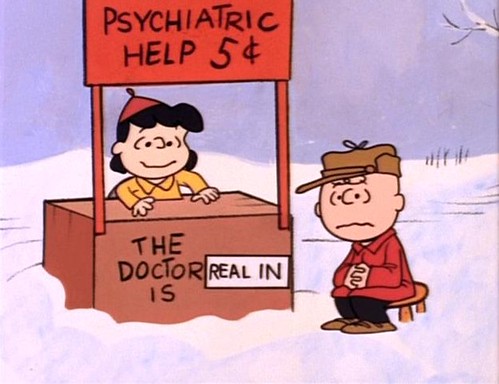
My Discipline

frankieleon, "discounted therapy," October 14, 2009 via flickr, Attribution Generic 2.0 License

In this blog post, I will be discussing the field of Psychology, including careers in Psychology and current leading researchers and academic journals in Psychology. I will also talk about my own interest in Psychology and what a typical Psychology student learns about.

Psychology is the study of the human mind, cognition, and behavior. Students in Psychology learn how people think and behave in different situations, how psychological research is conducted, and about various mental illnesses and different treatments for them.

People who study Psychology can go on to work as therapists, social workers, doctors (such as Psychiatrists), teachers, and researchers.

I, personally, was drawn to this field because I took an AP Psychology course in high school and loved it. I love learning how people think and why people act the way that they do. I've always loved interacting with people and Psychology is the science behind all of that.

The influential people and leaders in Psychology are predominantly researches. Albert Bandura is one of these very influential researchers. He has worked in different areas of Psychology for over 60 years, and has pioneered theories of social learning (learning through observing others) and self-efficacy (the belief in one's ability to succeed in a particular situation).

Elizabeth Loftus is another influential Psychological researcher who has studied the creation of false memories due to suggestion and how these impact eyewitness testimonies. Because of this, her work has impacted not only Psychological thinking, but also the field of Law.

The current top Psychology Journals include the Annual Review of Psychology, published by Annual Reviews, JAMA Psychiatry, published by the American Medical Association, and Behavioral and Brain Sciences, published by Cambridge University Press.

Update:
After reading Jessi Grossman's and Addie Stansbury's posts, I've come to realize how much our past experiences and the people in our lives can shape what we decide to pursue for careers. Jessi is also majoring in Physiology to become a doctor, but hers stems from her dad's positive influence, where mine comes from my love of Psychology. Addie's post helped me understand how important various and diverse majors are for the real world. I never really considered what a degree in journalism would entail but her post made me very interested in learning about it!

Saturday, August 29, 2015

My Thoughts on Comments

In this post, I will be looking at four comments on the Fantastic Four controversy article's thread. This article is from the website ScreenRant.com and its commenting thread has 249 comments.


Commenter A: hacknslash
 
http://screenrant.com/fantastic-four-2015-casting-controversy/
  1. Hacknslash seems to be upset that ScreenRant is supposedly changing their stance on this controversy from an earlier article, possibly from a different author. Hacknslash claims they are "stirring the pot."
  2. This commenter seems to have a big ego because he's criticizing a popular site.
  3. This commenter lacks credibility because of their username of hacknslash, their use of the words "sum" and "mofo," and generally angry tone.


Commenter B: Timmy

http://screenrant.com/fantastic-four-2015-casting-controversy/
  1.  Timmy seems to be upset that other minority groups are not as well-represented as black people, while ignoring how the most well represented group in the media by far are white people. He almost seems upset that black people are getting so much media representation.
  2. This commenter seems misguided and off-topic. He wants other minority groups to have more media attention, but seems to say that black people have too much representation.
  3. This commenter seems unreasonable because of how much he simplifies the issue of racial diversity in media. He never acknowledges that white people have a huge amount of representation, but still claims that black people have too much.

Commenter C: Ellie

http://screenrant.com/fantastic-four-2015-casting-controversy/
 
  1. Ellie seems to be supportive of the article's stance against the racist comments. She urges people to focus on the unimportance of the character's race for the plot, and points out Michael B. Jordan's talent.
  2.  This commenter seems to value the quality of the movie over the appearance of the characters. She also points out how if movie characters races are changed, many are changed from a minority to white.
  3. This commenter seems reasonable because she uses correct grammar and complete sentences. She also has solid logic and three labeled key points. She also establishes her credibility by telling us she is a writer herself.

Commenter D: commonsense


http://screenrant.com/fantastic-four-2015-casting-controversy/


  1.  Commonsense expresses anxiety about the siblings in the movie having two different races. He points out that it seems odd and "hard not to notice," suggesting it takes away from the quality of the movie as a whole.
  2. This commenter seems to value the flow of the movie. Commonsense is saying that these siblings having different races is distracting and doesn't help to make the movie as seamless as possible.
  3. This commenter subtly establishes credibility with their name, commonsense. This subtly suggests that what they're saying is common knowledge and everyone else should agree with their opinion. Also, this commenter says that they're fine with casting Michael B. Jordan before going on to talk about the problems it causes within the movie. So, commonsense is making sure we know that they don't have these opinions just because they're racist.

Update:
I read Cynthia Doan's and Breanna Featherston's posts. From Cynthia's, I have noticed that the more reasonable people spent more time explaining their opinion. Many of the people that write just a sentence tend to come across as more unreasonable. From Breanna's I've learned that I should use more direct quotes when I write. She used a lot of quotes and they helped point out exactly what she was referring to. They helped a lot with the flow of her writing!
Overall, I've learned that people tend to express their opinions much more aggressively on commenting threads than usual. Also, it takes a very calm and collected commenter in order to establish credibility because people are already prone to thinking that any comment is from an extreme source with no credibility, even though that may not be the case.

My Controversy

http://screenrant.com/fantastic-four-2015-casting-controversy/

The controversy I chose to address was about the casting choices for the 2015 Fantastic Four movie. This caught my eye scrolling through my google search results because I'm very excited to see this movie. I love superhero movies and I thought this re-vamp of the Fantastic Four franchise looked great.

I found out that the controversy surrounding Fantastic Four had to do with the director Josh Trank's choice to cast a black actor, Michael B. Jordan, as the Human Torch. Even though he is a fantastic actor with an impressive background, many people spoke out against the decision because he was black. The article on ScreenRant.com explains that many of these comments are hateful and racist. I was very disappointed to see this ridiculous and racist criticism.

Calendar Reflection

Pruitt, D. Sharon, "Free College Pathology Student Sleeping Creative Commons," May 3, 2011, creative common license

In this post, I will be reflecting on my time management for the semester. I need to schedule 6 hours of homework time a week for English 109 outside of class and that sounds daunting to me.

I normally am poor at managing my time, but I've actually found it a little easier at college so far. Because I have so much more time that I'm not in class compared to high school, I've been finding it easier to get everything done.

I plan to go to the library or other places to study during my breaks between classes. This makes use of all the time that I have, especially so I don't spend it walking all the way back to my dorm just to study.

I'm very optimistic about my ability to manage the college workload.

But I'm worried that I might have false hope.

Update:
After reading Chloe's (http://chloeenglish109h.blogspot.com/2015/08/calendar-reflection.html?showComment=1440916985582#c6978151731256986858) and Lauren's (http://97laurenhart.blogspot.com/2015/08/calendar-reflection-when-i-first-looked.html?showComment=1440917229463#c5371228545198723121) blogs, I feel encouraged to have a positive attitude about my weekly schedule in college. Both of these girls are managing their time so well, and their posts have given me hope for having success with my own time management. I definitely agreed with Lauren's idea of using the library to study because it's so close to my classes.

My Writing Process

abac077, "Computer World," Sept. 27, 2007 via flickr, attribution non-commercial share alike license

My first blog post is a reflection on my personal writing process.

1. What type(s) of writer do you consider yourself to be?

I consider myself to be a heavy reviser. Often when I start writing I get into a sort of rhythm. Soon into the process, phrases start coming to me before I'm ready to type them and so I just hit "enter" a few times and leave them at the bottom of the page. Then once I get to the section where I wanted that phrase or sentence to go, I put it in as I type. I normally work through the paper from beginning to end and then go back and revise it more.

2. Does your writing process include several approaches?

I also tend to be a bit of a procrastinator. I believe this is because when I do schoolwork, I often do a lot of one subject at a time. So then I'll have a lot done for Math, but not so much for English. I also tend to convince myself that I need a lot of time to write all at once, because most of the time I do. Once I start writing and get into a rhythm, I feel as if I can't stop or else I'll forget to put something that I liked into my paper. So because of this, I often write my papers in one day or afternoon...which unfortunately often happens to be the last one.

3. Does your writing process seem to be successful? What are the strengths and weaknesses of your approach?

I think my writing process if successful for me. At the end of it I am often very happy with the paper I've written. One of the biggest strengths of my process is that it allows me to write the end of my paper in the same rhythm as the beginning of my paper. This often keeps my voice consistent and helps it flow better. Probably the biggest drawback of my process is that it encourages procrastination. So as a result, some nights before big deadlines end up being filled with a lot of stress and not a lot of sleep.

4. Do you think it might be beneficial to you to try a different approach? Why or why not?

I have tried to write by creating outlines beforehand, but that often doesn't work for me. I normally just end up starting to write sections of my paper instead of planning an outline. However, I sometimes make an outline as I'm writing my paper to make sure I include everything that I want to.

Update:
After reading and commenting on Annelise's (http://adutcher109h.blogspot.com/2015/08/my-writing-process.html?showComment=1440916405086#c1349054367934476623) and Betsie's (http://bdries109h.blogspot.com/2015/08/my-writing-process.html#comment-form) blogs, I feel better about my tendency to procrastinate. I still don't think it's a good thing because of the stress it causes, but I know that not all writing after procrastination is bad quality because of how well these two girls write. I really enjoyed reading their blogs and it gave my insight into different styles and voices for writing.